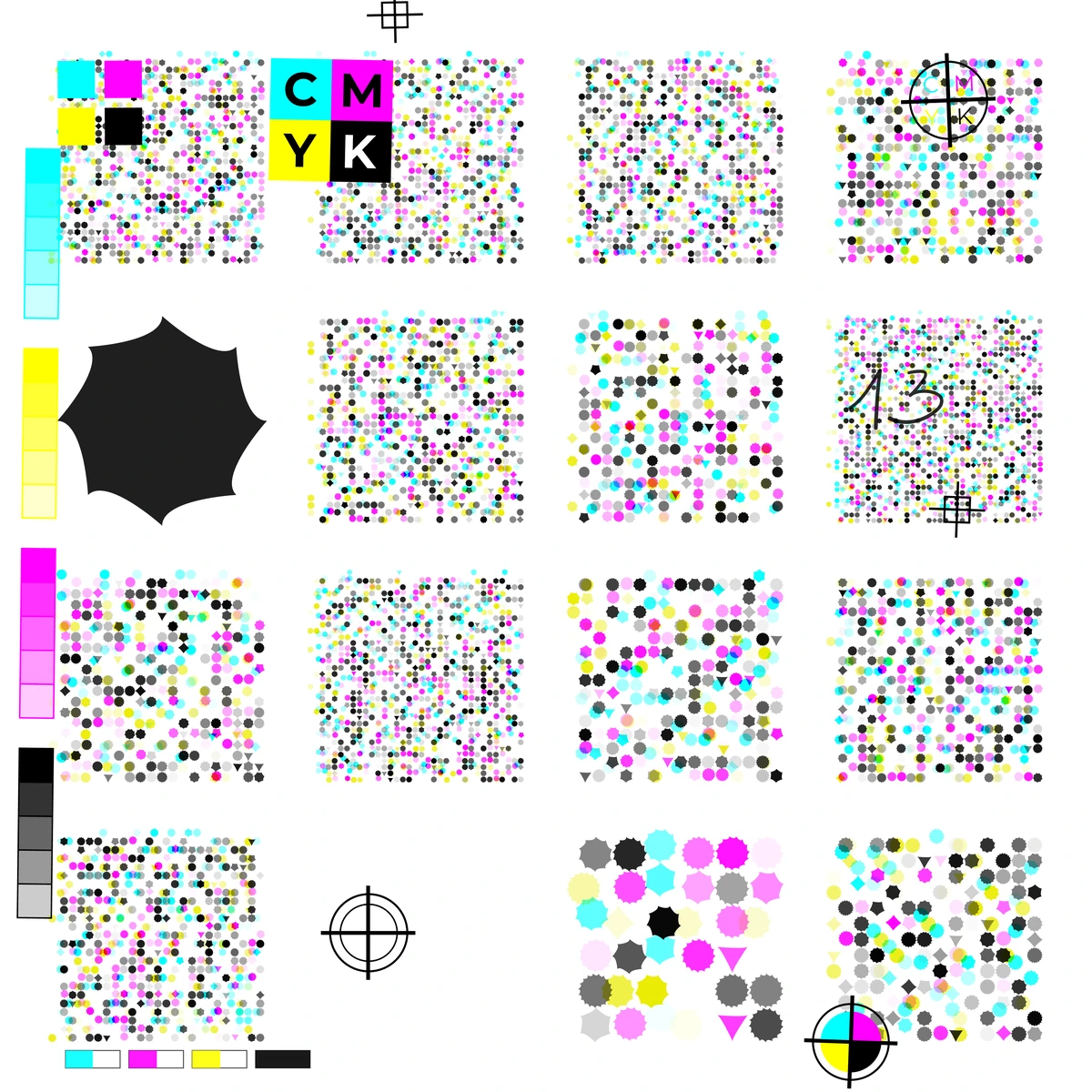
cmyk
A print shop rebuilt as a generative system.
The piece does not draw a picture of printing. It runs a press, and the sheet is whatever comes off it.
Each piece is a page coming off a press that does not exist: process plates or a single Pantone spot, laid down in true press order as fields of polygons and numerals I drew by hand, with the furniture of prepress left visible. Registration crosses. Calibration bars that actually measure the sheet in front of them. Plate labels, proof annotations, the notes a pressman leaves for himself.
The press is honest. Plates drift out of register on proofs, ink swells in the midtones, a sheet occasionally ghosts the one before it, dust leaves a hickey in the ink. Half the edition are proofs and carry the marks of checking; half are finals, dead-registered and clean.
the press run
Open a piece and it prints itself. The job ticket comes up first, then the plates lay down in press order, then the proofing marks land on top. About 13 seconds, once, and then the sheet settles. The settled frame is the work.
One token in ten runs on a failing press. Those keep going after the sheet settles, walking further out of register while you watch, the same way every time for that token. Reload and the piece is minted-perfect again. A rarer one never recovers.
artist statement
cmyk began in a print shop. That is where art and design started for me: plates going down in a fixed order, sheets checked against their marks, a trade that wrote down everything it did. Twenty years of design and product work later, this is me going back.
It is both a love letter to the mechanical beauty of print and a reminder that even in perfect registration, imperfection leaves the best marks.
I can point at the exact place I mean that. I drew the numerals by hand in 2023, and their weight table still carries a mistake from that year: the 1 set is declared twice, so it turns up twice as often as most, and the 8 set sits low. I found the mistake while building the press. I kept it. The published odds are the real ones, mistake and all.
gallery
Sheets from the studio, chosen by hand. Not the edition, which is drawn at mint.
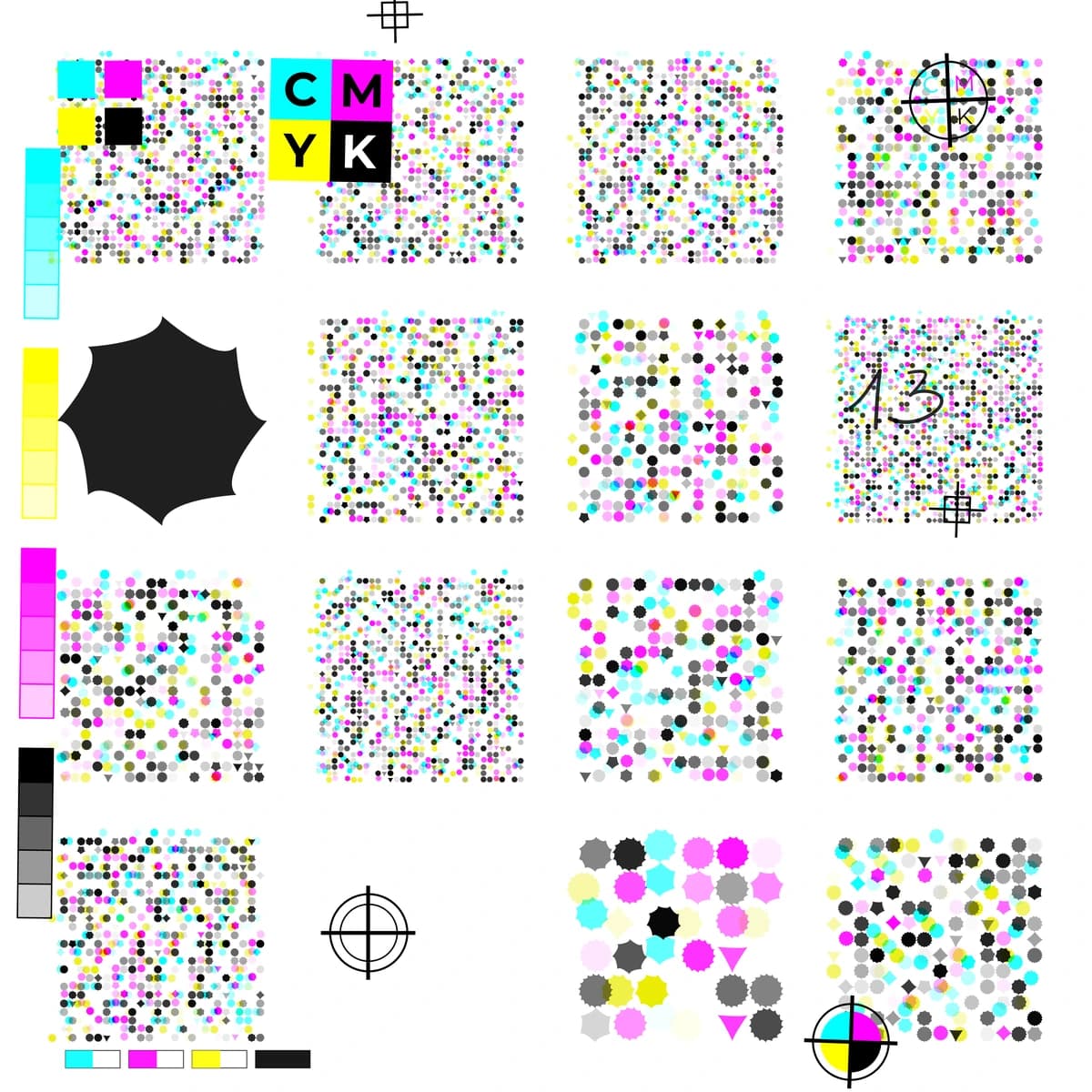
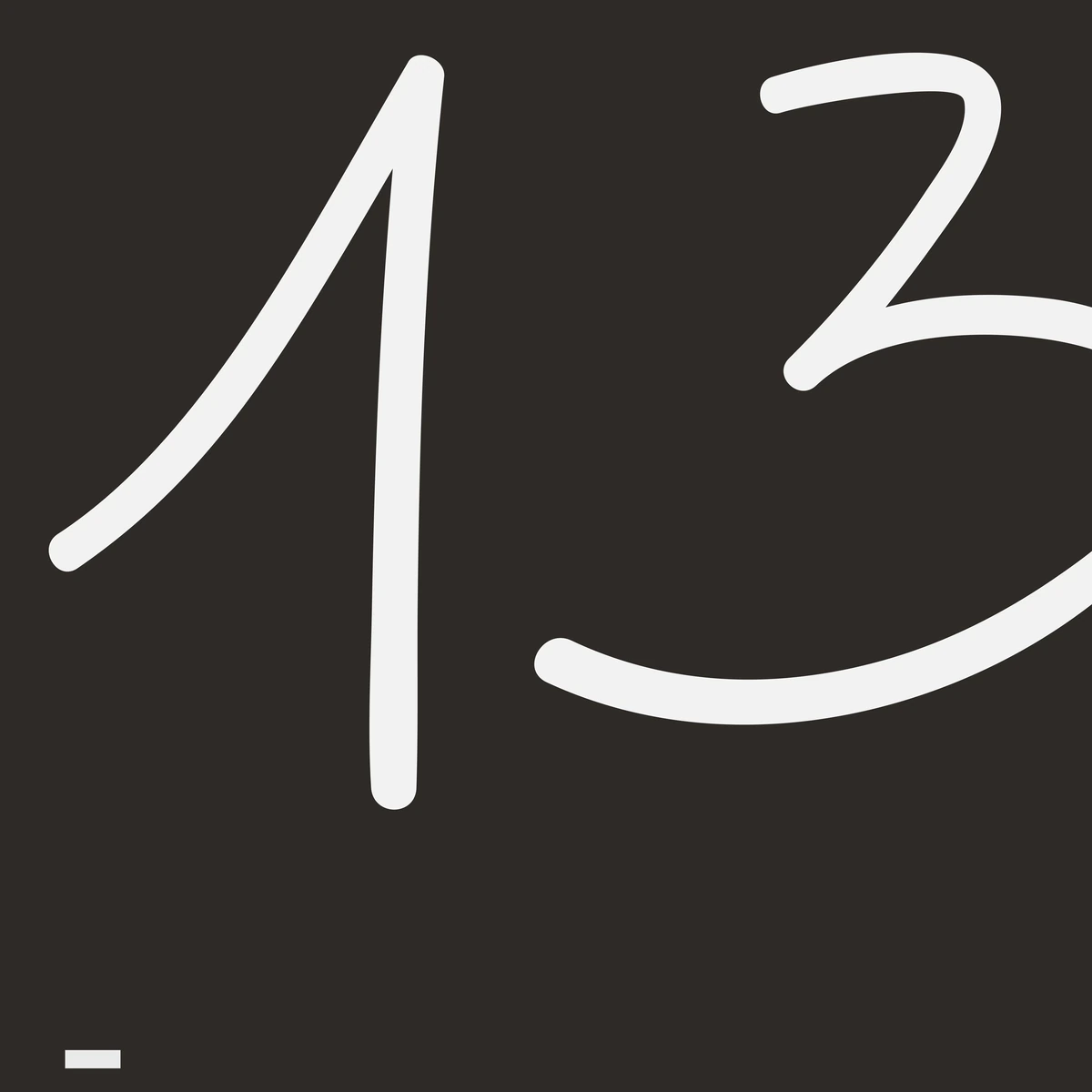
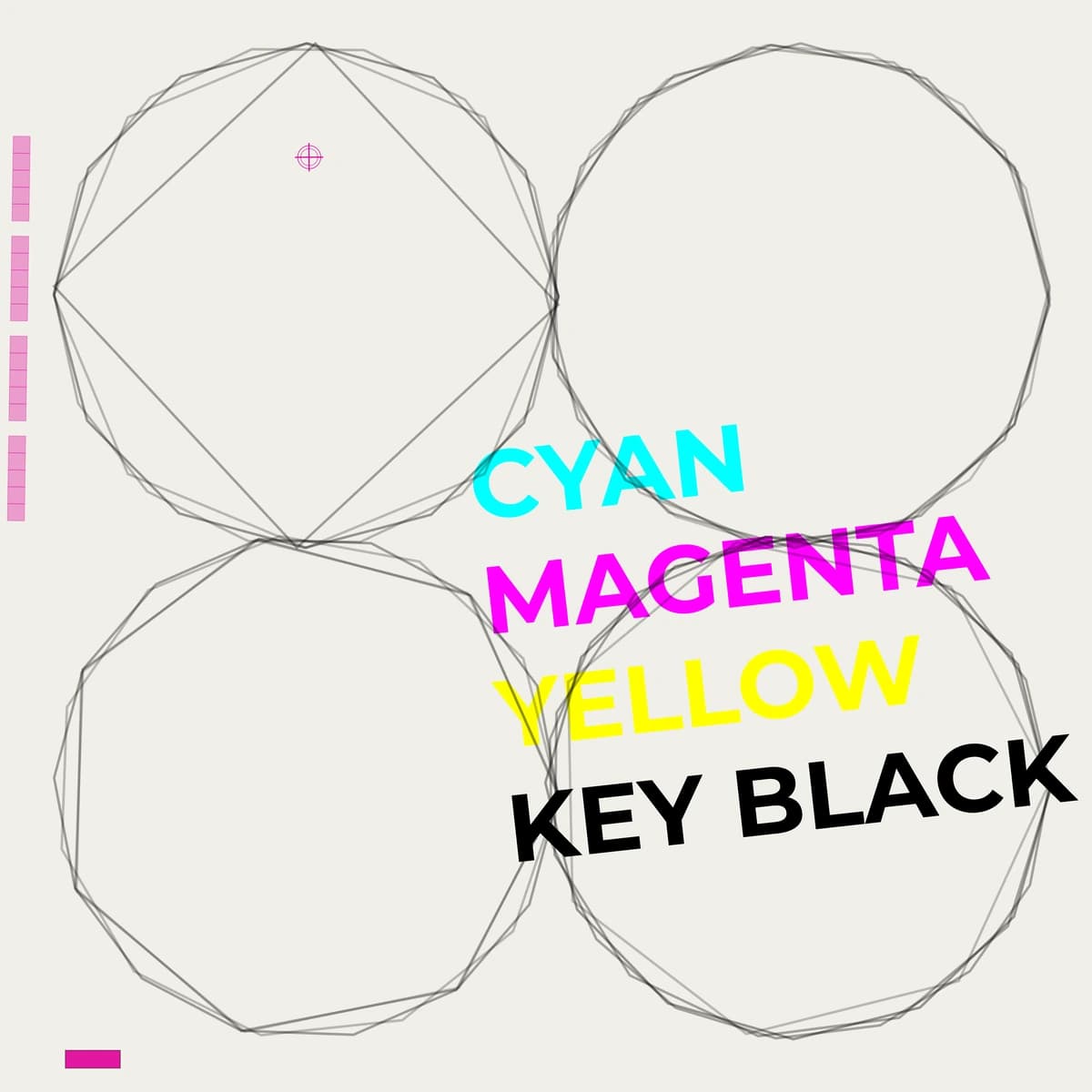
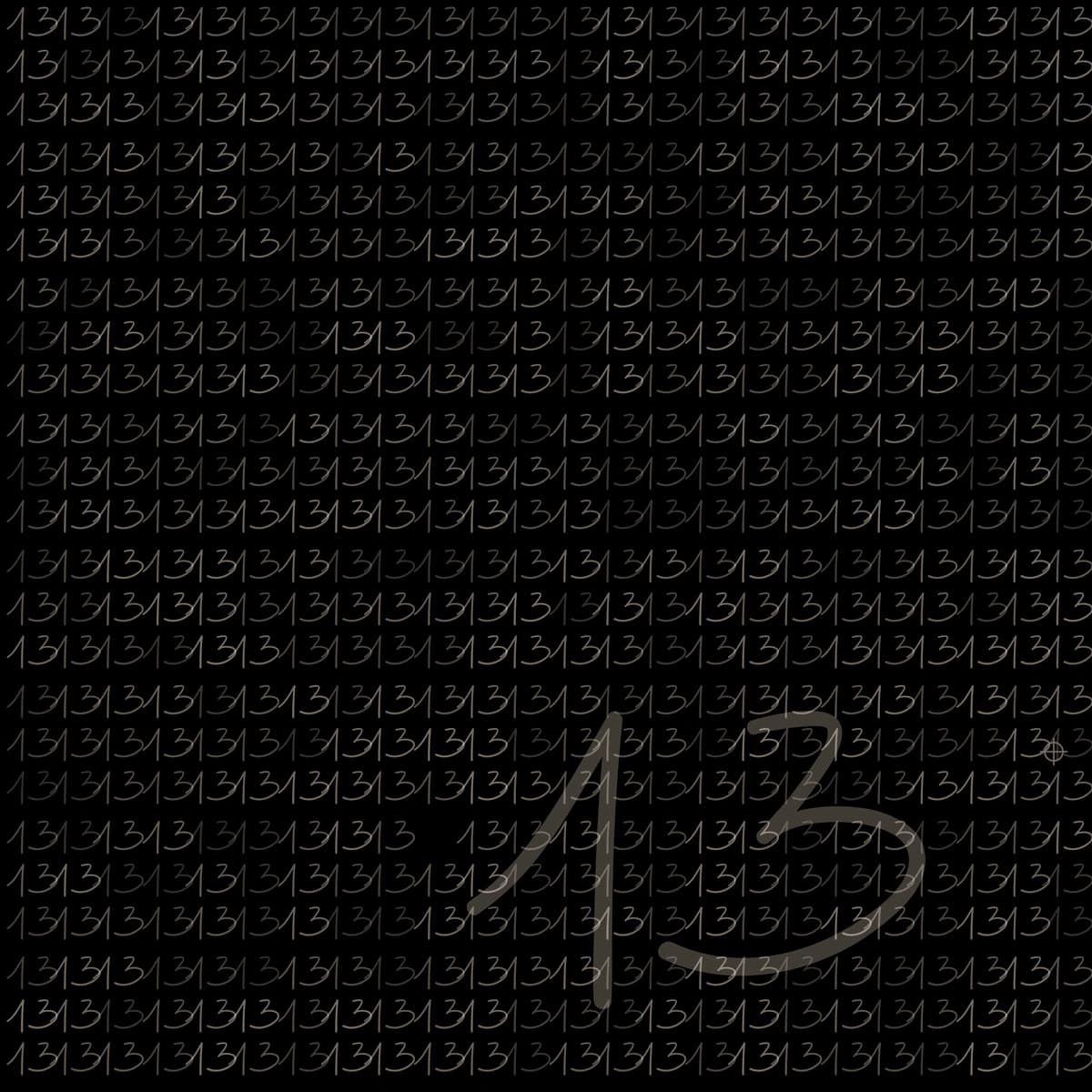
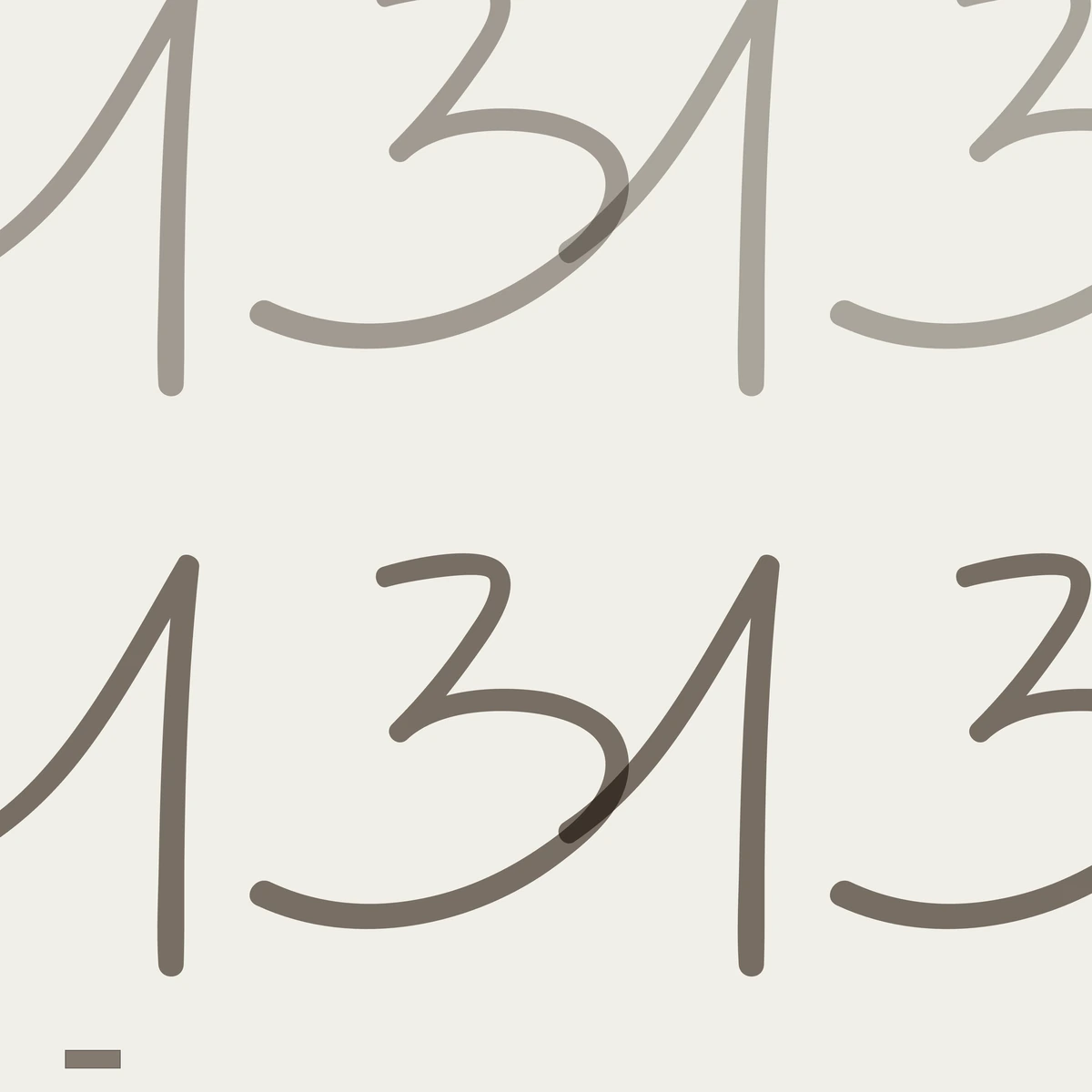
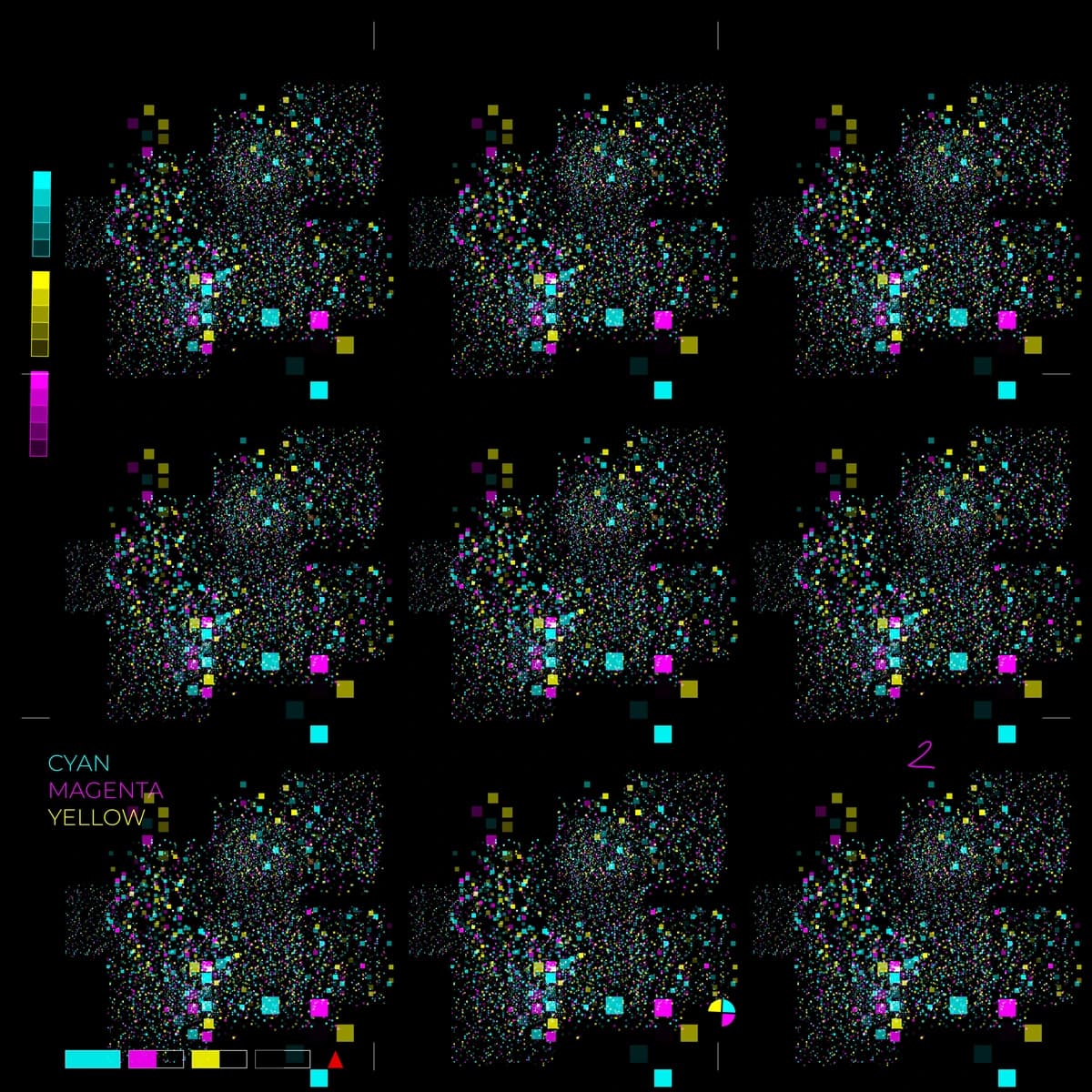
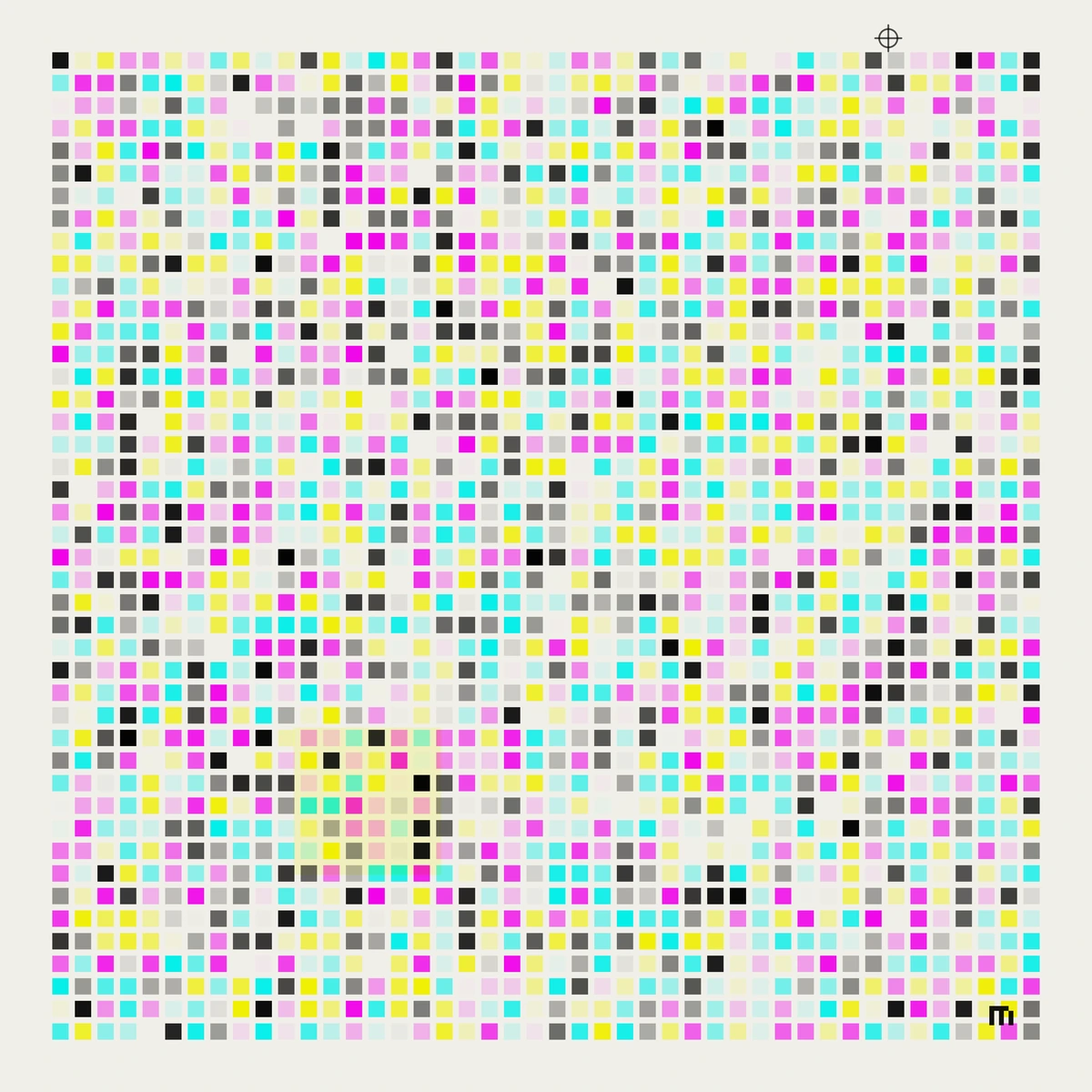
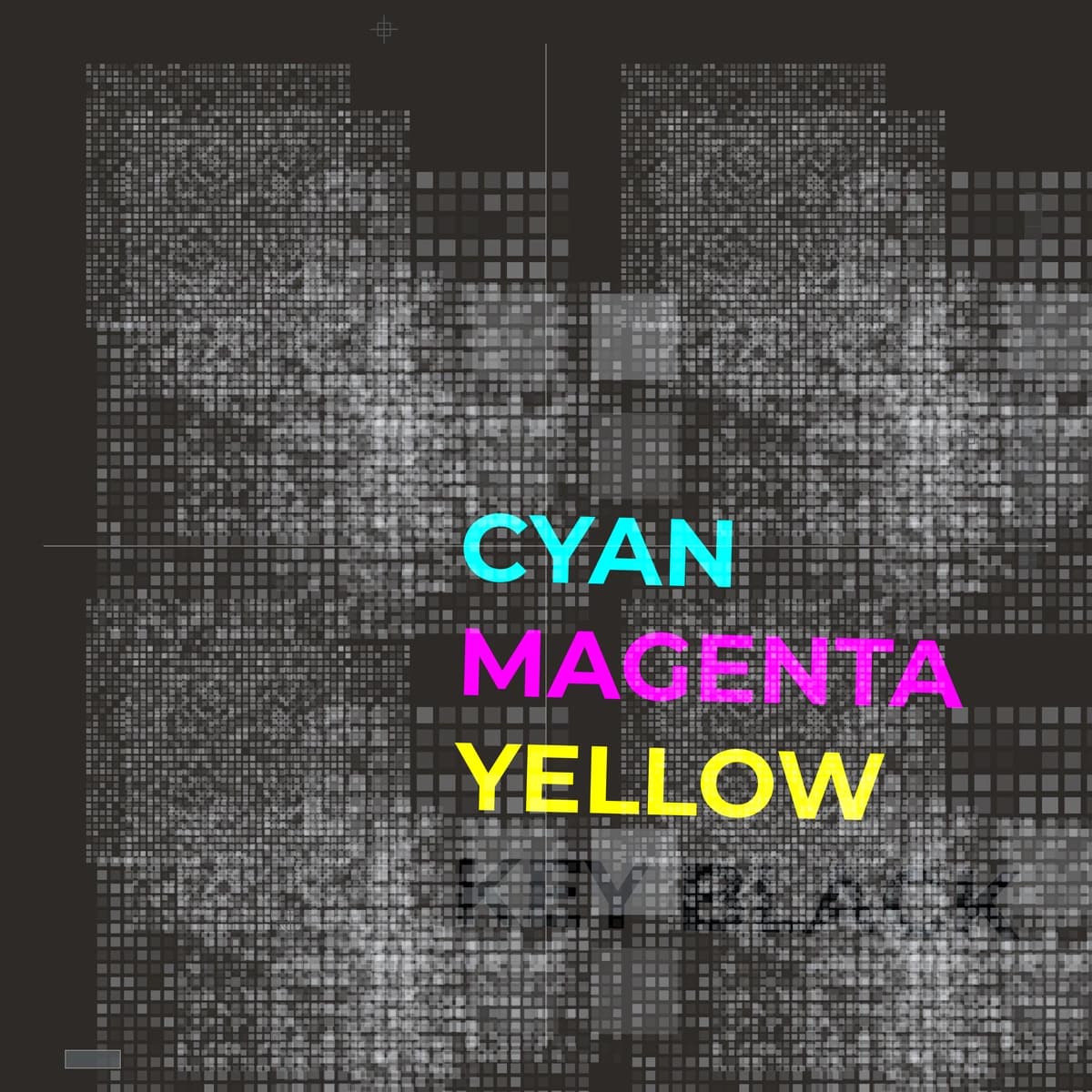
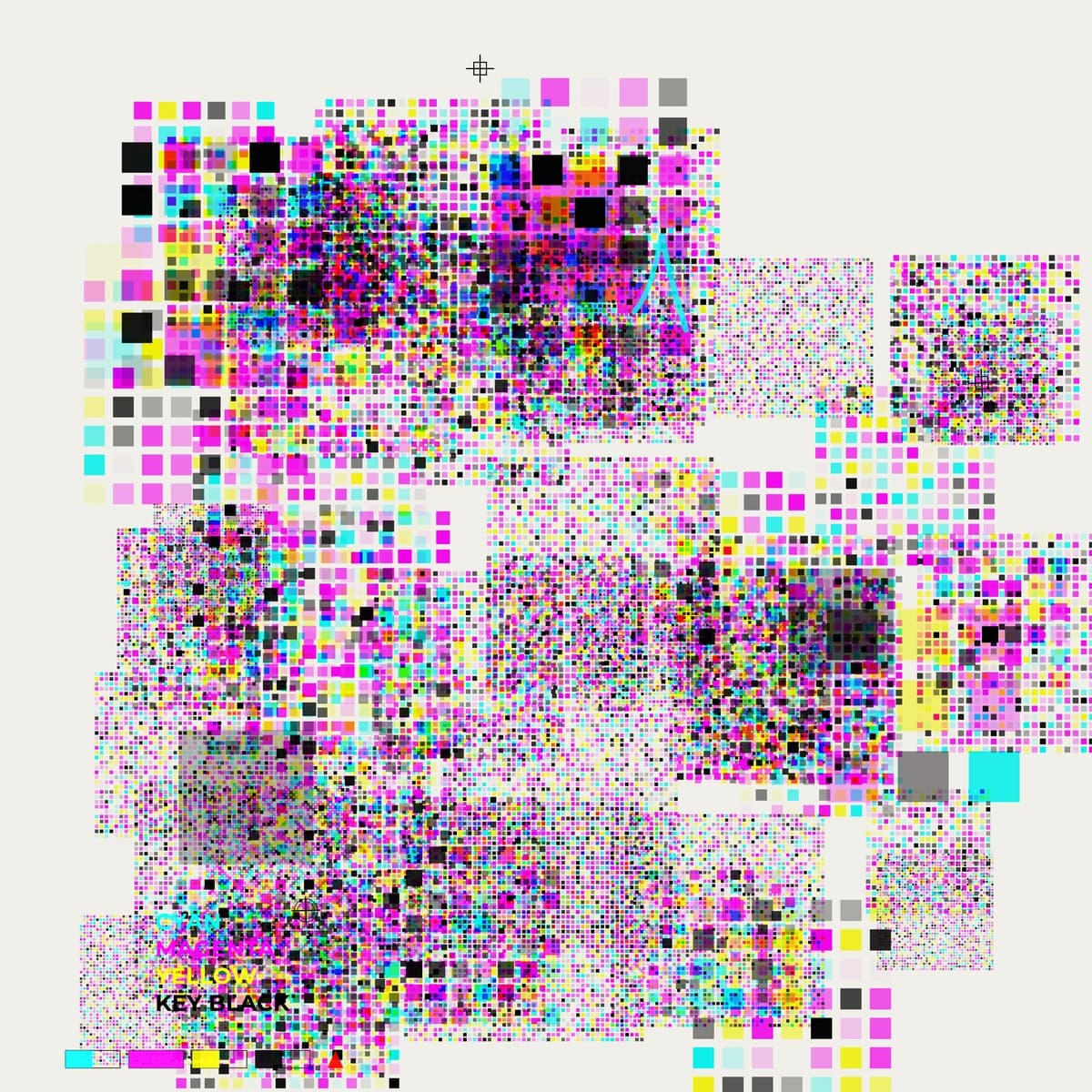
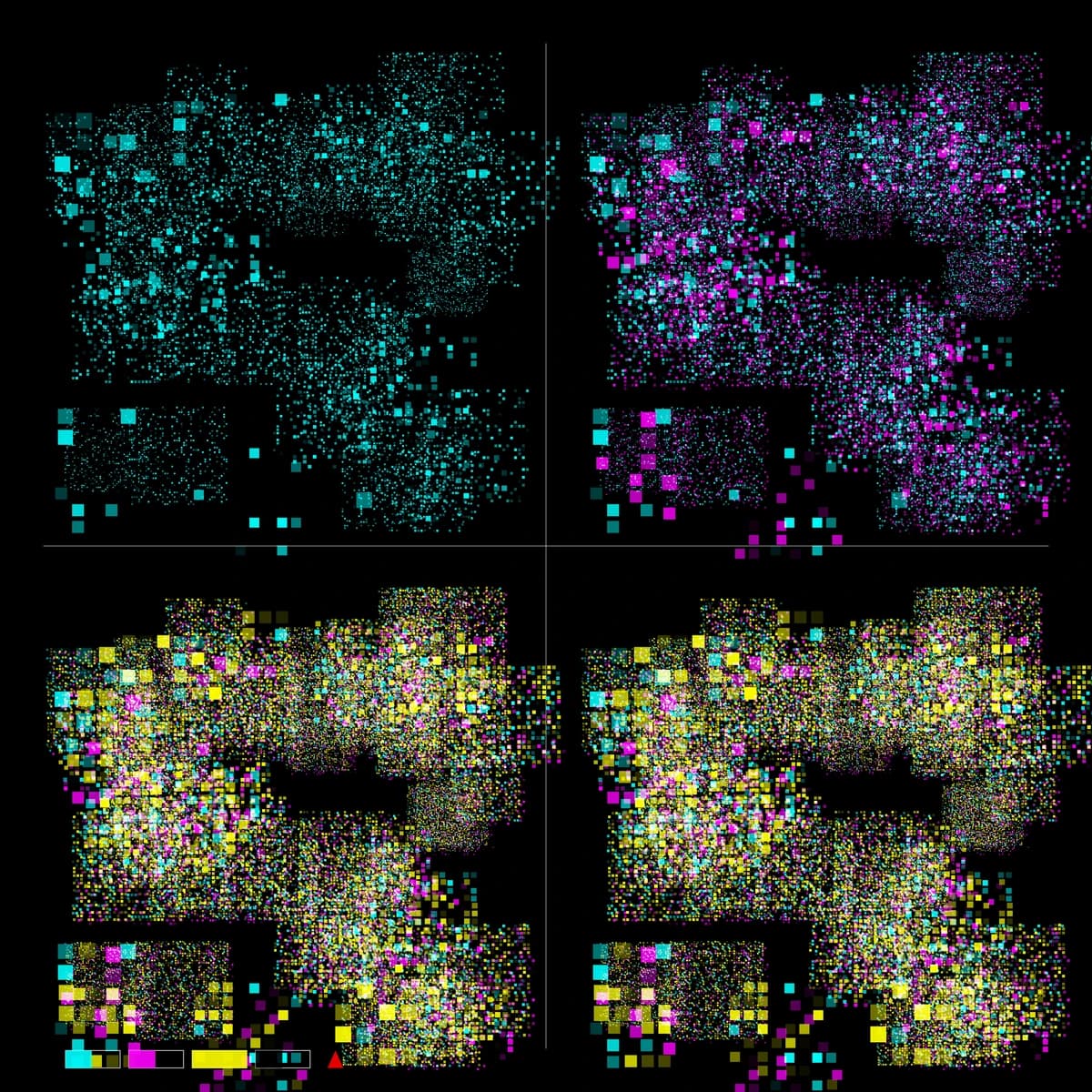
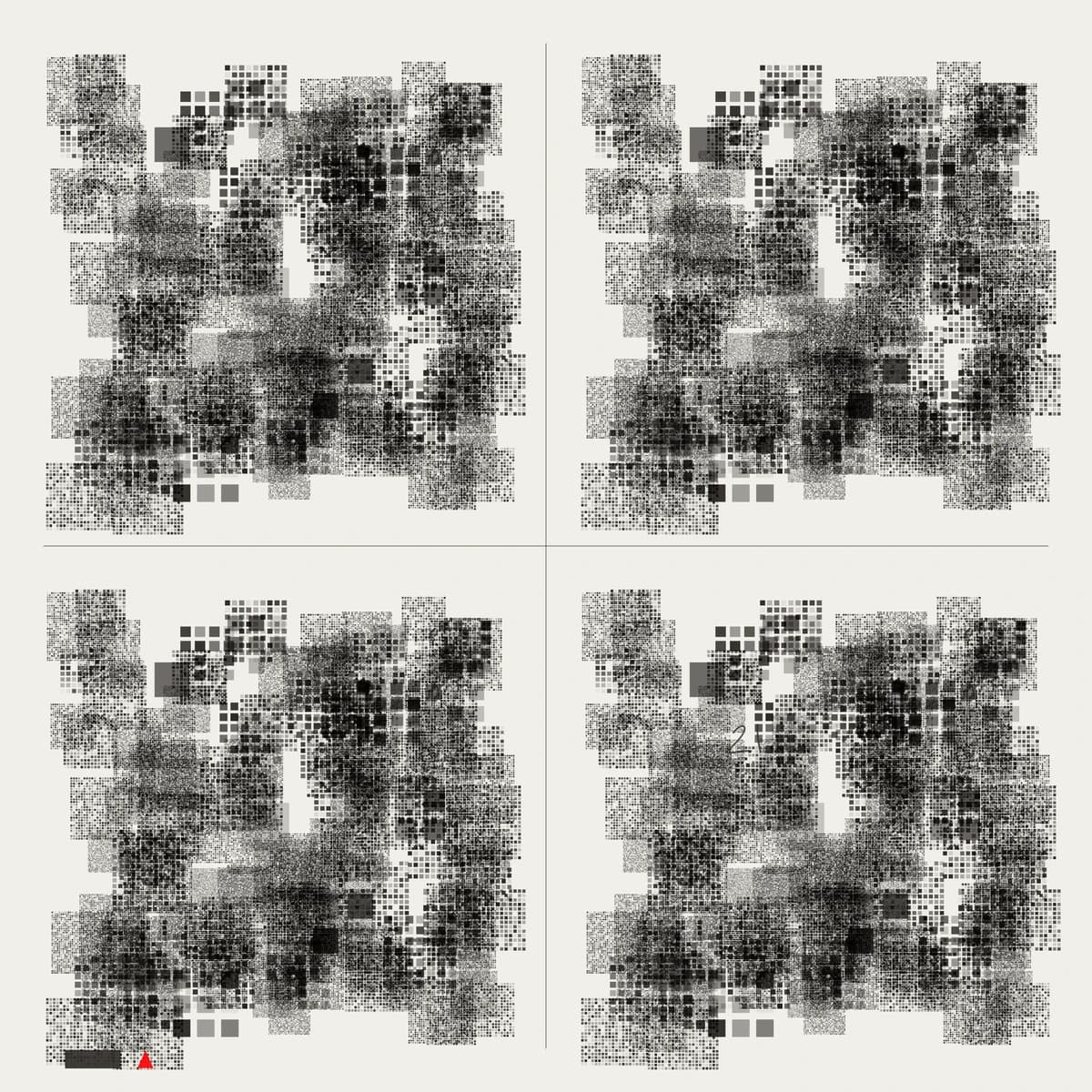
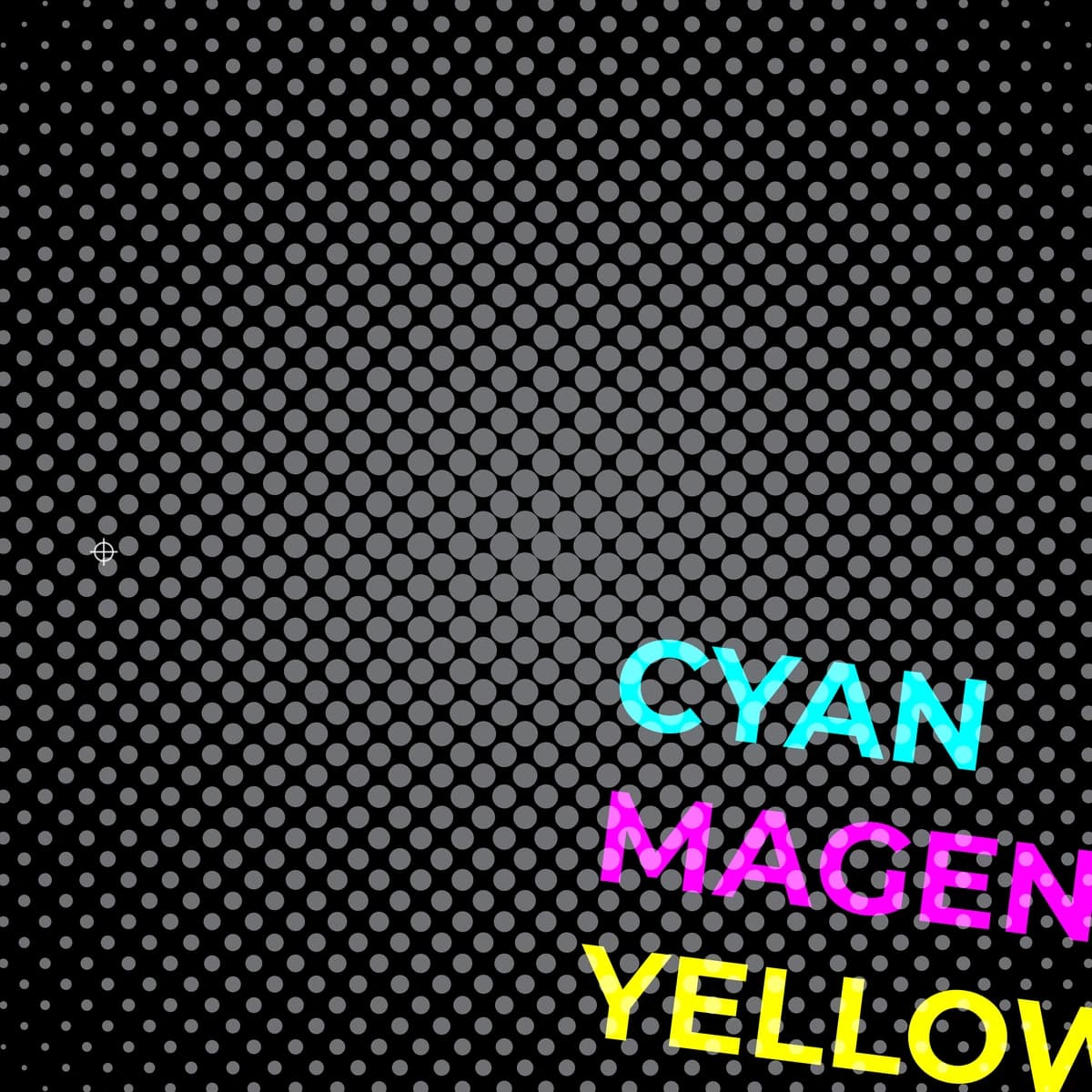
the numerals
Every structuring number is Fibonacci. The numerals - 1, 2, 3, 5, 8, 13, 21 - are hand drawn, and no machine has touched them since 2023. They are the alphabet the sheet is written in.
Each token writes its own hash in them, one Zeckendorf decomposition at a time, with a miniature registration cross standing in for zero. The sheet is not decorated with numbers. It is spelling something.
the lineage
cmyk stands in two older lines of work. From generative art: Georg Nees, whose Schotter walked a grid out of order in 1968, and Vera Molnar, who ran an imaginary machine by hand and measured out disorder a percent at a time. From print: Josef Albers teaching color as separations, Warhol letting the screen slip, Lichtenstein and Polke making the halftone dot the subject, Wade Guyton painting with a jammed printer. A press drifting out of register belongs to both histories. This one runs live.
There is precedent, too, for digital work that decays while you watch. cmyk's decay is scored rather than open-ended: hash-seeded, capped on all but one press, and canonical in its clean state. The damage is a performance the sheet gives, not a thing it becomes.
The numbers come from the trade. 144 is a gross, twelve dozen, the unit a shop counted sheets in, and the only Fibonacci number after 1 that is also a perfect square. The press run takes 13 seconds. Neither is decoration.
traits and rarity
Every rate below is the weight declared in the engine. The edition is a draw, not a quota: each mint takes its own hash, so the counts in the 144 will land near these numbers, not exactly on them.
plates
Whether the sheet runs four-color process or a single Pantone spot.
| Value | Rate | Odds | Expected of 144 |
|---|---|---|---|
| process color | 70% | - | 101 |
| spot color | 30% | - | 43 |
stock
The paper. Marshmallow is the warm off-white the shop ran most; Black C is the rich black that makes the inks glow rather than sit.
| Value | Rate | Odds | Expected of 144 |
|---|---|---|---|
| 11-4300 TPX (Marshmallow) | 45% | - | 65 |
| black | 30% | - | 43 |
| Black C | 15% | 1 in 7 | 22 |
| white | 10% | 1 in 10 | 14 |
form
What is on the sheet. Twenty-two of them: the classic fields the piece was built on, the press-native forms (the ramp, the separations, the makeready), and the quiet end (the inkless emboss, the single mark).
| Value | Rate | Odds | Expected of 144 |
|---|---|---|---|
| outline | 15% | 1 in 7 | 21 |
| squares | 7.3% | 1 in 14 | 11 |
| thirteen | 7.0% | 1 in 14 | 10 |
| progressive proof | 6.8% | 1 in 15 | 9.8 |
| plate separations | 6.8% | 1 in 15 | 9.8 |
| regular polygons | 6.0% | 1 in 17 | 8.6 |
| packed polygons | 5.0% | 1 in 20 | 7.2 |
| random polygons | 5.0% | 1 in 20 | 7.2 |
| makeready | 4.8% | 1 in 21 | 6.9 |
| Zeckendorf field | 4.8% | 1 in 21 | 6.9 |
| imposition | 4.8% | 1 in 21 | 6.9 |
| cubes | 4.0% | 1 in 25 | 5.8 |
| blind emboss | 4.0% | 1 in 25 | 5.8 |
| ink draw-down | 3.5% | 1 in 29 | 5.0 |
| press furniture | 3.0% | 1 in 33 | 4.3 |
| Fibonacci | 2.0% | 1 in 50 | 2.9 |
| 02 | 2.0% | 1 in 50 | 2.9 |
| halftone ramp | 2.0% | 1 in 50 | 2.9 |
| moire | 2.0% | 1 in 50 | 2.9 |
| curvilinear polygons | 1.7% | 1 in 59 | 2.4 |
| type specimen | 1.5% | 1 in 67 | 2.2 |
| single element | 1.2% | 1 in 83 | 1.7 |
sheet
A proof carries the marks of checking. A final is dead-registered and clean, and carries one perfect registration cross in the field.
| Value | Rate | Odds | Expected of 144 |
|---|---|---|---|
| proof | 50% | - | 72 |
| final | 50% | - | 72 |
run condition
The press this token runs on. A failing press walks out of register while you watch it. A catastrophic one never stops.
| Value | Rate | Odds | Expected of 144 |
|---|---|---|---|
| clean run | 89% | - | 129 |
| failing press | 10% | 1 in 10 | 14 |
| catastrophic | 0.7% | 1 in 143 | 1.0 |
Ink, grid, the Fibonacci sets, the three conditional traits, the events worth hunting, and what every mark on the sheet means.
at the press
The piece at the top of this page is the real one. Click it so it hears the keyboard, then take it apart.
Prints are re-run, never upscaled: the paint program executes again into a larger buffer, so a 120 cm print carries the same geometry as the sheet on screen. The largest size takes a moment and wants a desktop browser. There is a save control on the piece itself if you would rather not use the keyboard.
for collectors
A token is the sheet, the system that printed it, and the paper trail. Each piece renders live from its hash and carries its own provenance record: plate order, measured ink coverage, registration offsets, dot gain, and the position of every press error. Every mark on the sheet came from somewhere, and the record says where.
The piece is deterministic and needs no server. The same hash prints the same sheet on any machine, at any size, with no server in the loop, and the piece exports its own print-scale file. They are holding the press.
Edition of 144 on Verse at 13 dollars, about 0.005 ETH, first come first served from Thursday 1 October 2026 at 11 am Eastern, no end date; the artist keeps token 1. Every file the piece runs on, including its copy of p5.js, is written into the collection contract on Ethereum. Secondary royalty 10 percent. License CC BY-NC 4.0. The odds for every trait, including the failing and catastrophic presses, are already on the provenance page; whether anyone owns the broken one is up to the draw.
the edition
An edition of 144. In final review, releasing on Verse in 2026.
An original work by michael, made with gratitude for the shop that started it.